
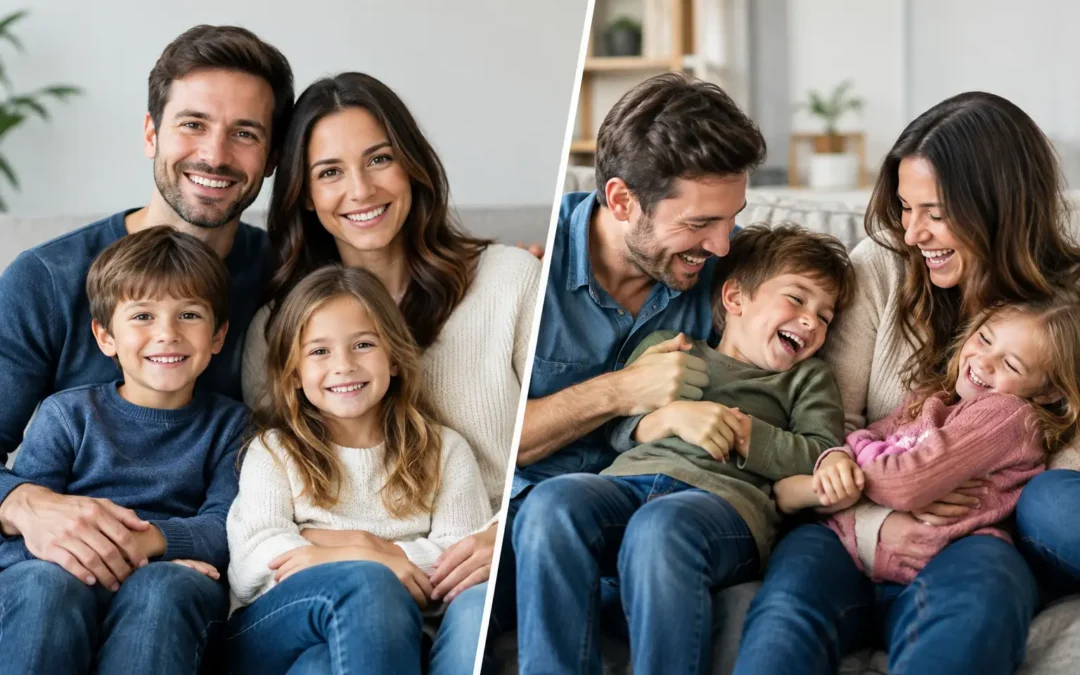
A child may only sit still for thirty seconds. A grandparent may arrive feeling camera-shy. Someone will probably need a snack just as the light looks perfect. That is exactly why the question of posed family photos vs candid images is less about choosing a single style and more about creating photographs that feel like your family.
The most successful family sessions make room for both. A beautifully composed portrait can become the photograph you frame, print and give to relatives. A candid image of your children laughing together, or of you looking at them rather than the camera, can bring back the atmosphere of this particular chapter of family life. Each has a different job to do.
Posed family photos vs candid: the real choice
Posed family photographs are intentional. Everyone is brought together, the composition is considered and the photographer guides where people stand, sit and look. This does not mean stiff smiles or unnatural arrangements. Good direction is gentle and practical: placing people where the light is flattering, making sure no one is hidden, and giving hands and shoulders somewhere comfortable to go.
Candid photographs are more observational. They happen while you walk, play, chat, cuddle or simply take a breather. Rather than asking everyone to look at the camera, the photographer watches for connection: a child reaching for a parent’s hand, siblings sharing a joke, or the quiet glance between two people who know each other well.
The choice is not really formal versus fun. It is about the balance you would like from your photographs. Most families want at least one image where everybody is visible and looking their best, alongside the looser moments that show personality and affection.
What posed portraits do especially well
A posed portrait gives a family a sense of occasion. It is particularly valuable when the whole group is together, perhaps for a milestone birthday, anniversary, new baby or rare visit from relatives. Coordinating several generations is not easy, and a carefully arranged image makes sure that everyone has a place in the photograph.
These images also work beautifully for wall art and gifts. There is a pleasing clarity to a well-composed family portrait: faces are visible, the frame feels balanced and the eye knows where to look. Years later, it can become a small record of who was there at that moment.
For parents, posed photographs can offer reassurance. You may worry that your children will not cooperate, that your partner dislikes having their picture taken, or that you will not know what to do in front of the lens. Clear, relaxed guidance changes that. You do not need to perform. You simply need a photographer who can organise the group without making it feel like hard work.
There is a trade-off. If every picture is tightly directed, a session can start to feel rushed or over-managed, especially with young children. The answer is not to abandon portraits, but to take them at the right time – often early in the shoot, when everyone is fresh – and then allow the session to breathe.
Why candid images often become family favourites
Candid family photographs carry movement and feeling. They preserve the details that parents often miss while managing the day: the way a toddler presses their cheek into your shoulder, a child’s determined concentration while climbing a low wall, or the delighted chaos of a game in the park.
They are especially useful for children who become wary when asked to smile on demand. A relaxed activity gives them something to focus on other than the camera. Walking together, collecting leaves, having a race or sharing a story creates genuine expressions without forcing a moment that is not there.
Candid does not mean unplanned. The best natural-looking images still rely on professional judgement. Light, background, timing and position matter. A photographer may suggest moving a few steps towards softer light, slowing down for a moment, or asking you to gather close together. The resulting image can look spontaneous, while being carefully shaped behind the scenes.
The trade-off is that candid photographs are less predictable. A wonderful expression may come with wind-blown hair, a child looking away or imperfectly matching outfits. For many families, that is part of their charm. But if your priority is a polished group image for a particular purpose, candid photographs should complement, rather than replace, the posed portraits.
The best approach for families with young children
For younger children, flexibility is everything. A session built around their energy and curiosity is more likely to produce relaxed, expressive photographs than one built around long periods of sitting still. Start with a few simple family portraits, then let the children move.
Parents sometimes feel they must keep children perfectly behaved for the camera. Please do not put that pressure on yourselves. A little wriggle, laughter or refusal to wear a coat is completely normal. Children respond far better to warmth, play and a calm pace than repeated instructions to say cheese.
It also helps to choose clothing that allows movement and feels like you. Coordinating colours can look polished, but everyone does not need to match. Soft, complementary tones tend to photograph well, while favourite jumpers, dresses or tiny wellies can add character. Comfort matters, because it shows in faces and body language.
When a more posed session may be right
There are occasions when formal structure deserves a larger role. A multi-generational gathering, for example, benefits from a clear plan. Photograph the full group first, then smaller combinations: grandparents with grandchildren, siblings together, each family unit, and perhaps a couple portrait too. This makes sure no meaningful arrangement is missed.
A posed approach can also suit families who want a refined, timeless look for their home. Studio-style portraits, or an outdoor setting with a clean and uncluttered background, allow attention to stay on expression and connection. The result can still feel warm. Formal need not mean distant.
If you have older children or teenagers, a little direction can be helpful as well. They may appreciate knowing exactly what is expected, rather than being asked to improvise. Once the initial portraits are done, conversation and gentle interaction usually bring out more relaxed images.
How to get both styles in one family shoot
The simplest way to plan a session is to identify your non-negotiable photograph. It might be one image of everyone looking at the camera, a portrait of your new baby with older siblings, or a picture for grandparents. Tell your photographer before the session begins so it can be prioritised while energy levels are high.
After that, leave room for real life. Hold hands on a walk, sit close together, look at your children, tell a silly joke or take a moment to chat. You do not have to manufacture big emotion. Small interactions often photograph most beautifully.
At Henrietta Photography, the aim is to make families feel looked after rather than posed into place. Thoughtful direction creates the polished portraits you will be proud to display, while a relaxed atmosphere leaves space for the candid moments you could never plan.
Choose photographs that will still feel like you
The question is not whether posed family photos or candid images are better. It is which memories you want to hold on to, and how you want your family to feel when they see them. A composed portrait says, “we were all here.” A candid frame says, “this is what being together felt like.”
Give yourself permission to want both. Come dressed comfortably, allow plenty of time, and let the people you love behave like themselves. The most lasting photographs are not the ones that prove everything was perfect. They are the ones that make you feel the warmth of that day again.